What is typography? the dna of information

Fredy Polania
Product Strategy • Visual Communication • Web Development
Much More Than “Letters”
Typography is another name for the letters of the alphabet, but its real weight is incalculable. It is one of the fundamental elements not only in visual communication but also in the development of human civilization.
1. Etymology and the Origins of Writing
The term typography originates from the Greek Typos (impression) and Graphia (writing); hence, we can translate its combination as “printed writing.” As human craft progressed to manipulating metal alloys and automating processes through machinery, the word “type” acquired an additional meaning: a letter, number, or symbol.
As I briefly mentioned in the article Everything is Design, the development of writing was one of the most significant inventions in building modern society. The earliest record of its origins dates back to the Sumerians, who used wedge shapes on clay tablets to create a system of symbols, initially designed to audit and catalog harvested crops, among other administrative uses.
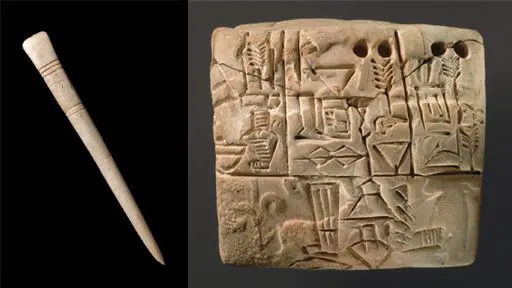 Sumerian wedge and clay tablet. Source unknown
2. The Preservation of Knowledge: From Scrolls to Books
Once writing was integrated into human life, we naturally began to collect writings. Initially, manuscript scrolls made from animal skins—and later from materials like papyrus or silk—allowed us to record knowledge for centuries. Although relatively easy to store and handle, scrolls were highly inconvenient because they forced scribes to write on only one side, and retrieving specific information across a long scroll was difficult. These limitations laid the groundwork for the development of the codex, and eventually, the book as we know it today.
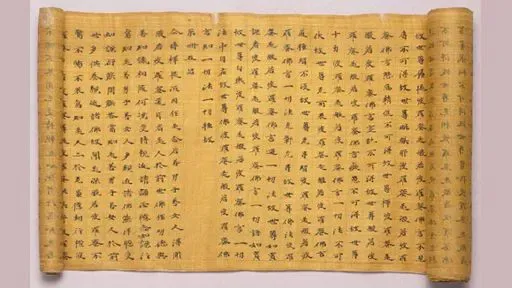 Manuscript scroll ‘The Great Virtue of Wisdom’. Source
3. The Book of Kells: Medieval Masterpiece
The Book of Kells, also known as the Book of Columba, is the finest surviving example of the medieval manuscript tradition. Despite being fully illuminated and written by hand, it is characterized by its extraordinary detail and craftsmanship, making it a critical reference in the early history of book production. In graphic design, it stands as one of the earliest examples where illustration and typography integrate as primary elements of visual communication.
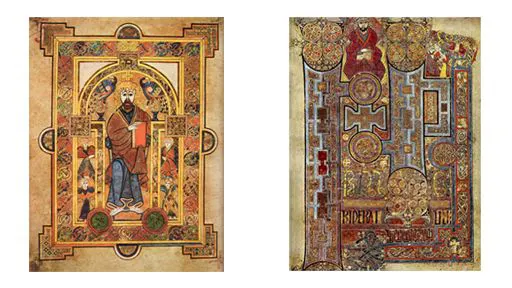 Christ on the Throne (left) and the opening page of the Gospel of John (right) from the Book of Kells. Source
4. Gutenberg’s Printing Press: The Second Millennium Milestone
Johannes Gutenberg was a German blacksmith, goldsmith, inventor, printer, and publisher who introduced printing to Europe. His printing press is widely regarded as the most important event of the second millennium.
Among his multiple contributions to printing are the development of a process for the mass production of movable type, the use of oil-based inks for books, adjustable hand molds, mechanical movable type, and the adaptation of the wooden screw press used in agriculture. These breakthroughs created a complete system that enabled the mass production of books, making them economically viable for both publishers and readers.
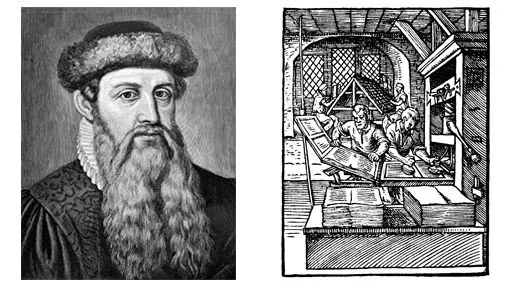 Gutenberg (left) and the wooden printing press (right). Source
5. Movable Type: The Mechanization of Text
Movable type is a system of printing and typography that uses mobile, reusable components to reproduce alphanumeric characters on paper. Although the earliest known movable type system was invented in China around 1040 AD using ceramic characters, its serial production was limited by material constraints.
Gutenberg’s invention enabled the mass production and rapid spread of movable type across Europe. Combined with innovations like casting metal type in hand-crafted matrices and molds, Gutenberg pioneered the creation of durable metal type alloyed from lead, tin, and antimony.
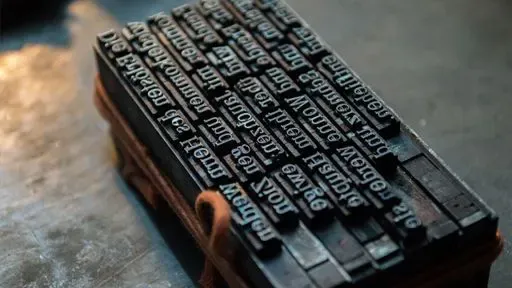 Movable type characters ready for printing. Source
6. Typography as Brand Voice
Undoubtedly, the innovations surrounding the printing press initiated the formal craft of selecting letterforms designed within a coherent system—defining character sizes, line lengths, line spacing (leading), and character spacing (tracking and kerning).
What we call typography today also refers to the style, arrangement, and appearance of the letters, numbers, and symbols created during this process. In my product architecture practice, typography is the brand’s voice. If the typography is inconsistent or illegible, the business loses visual authority. From the medieval illumination of Kells to today’s responsive digital interfaces, typography remains the ultimate tool for organizing and democratizing human knowledge.
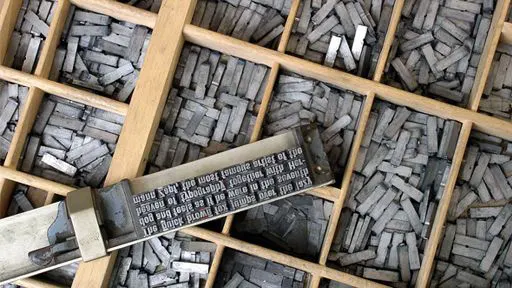
Movable type organized in drawers. Source